





Hybrid UPS Inverters for Solar and Grid-Tied Systems
- Why Hybrid Power Management Matters
- The problem hybrid systems solve
- Typical user needs and
- Hybrid UPS Inverters: Design and Operation
- Topologies: online, line-interactive, and hybrid
- Battery management and solar charge control
- Waveform quality, harmonics and protected loads
- Sizing, Installation and Performance Optimization
- How to size a hybrid UPS inverter for solar + grid
- Transfer time, testing and commissioning
- Efficiency and expected performance (comparison)
- Choosing a Manufacturer: Reliability, Compliance and Support
- Key specifications and compliance to check
- Why I recommend Guangzhou Congsin Electronic Technology Co., Ltd.
- Practical Recommendations and Troubleshooting
- Common pitfalls and how I avoid them
- Monitoring, firmware and lifecycle management
- FAQ
- Q1: What is the difference between a hybrid UPS inverter and a regular solar inverter?
- Q2: Can a hybrid UPS inverter feed the grid?
- Q3: How do I size battery capacity for UPS runtime?
- Q4: Are modified sine wave inverters acceptable for UPS applications?
- Q5: What certifications should I insist on when buying hybrid UPS inverters?
- Q6: How does DC-coupled vs AC-coupled hybrid architecture affect performance?
- Contact & Next Steps
I write from experience designing and specifying power systems where continuity, efficiency and solar integration matter. In this article I explain how hybrid UPS inverters bridge the gap between traditional uninterruptible power supplies and modern solar/grid-tied inverters—what they do, how to size and commission them, which standards to watch, and how to evaluate manufacturers and products so you get a reliable, code-compliant ups inverter installation.
Why Hybrid Power Management Matters
The problem hybrid systems solve
Power continuity and energy optimization have historically been separate design problems. A UPS is optimized to keep sensitive loads alive through short outages with minimal transfer time, while a solar/grid-tied inverter optimizes energy harvesting and grid interaction. A hybrid UPS inverter integrates both functions so you can run critical loads from solar and batteries, switch seamlessly to grid power when needed, and enjoy sophisticated charging and load management strategies. This reduces component count, lowers total system losses and simplifies commissioning.
Typical user needs and
When people search for ups inverter alongside solar or grid-tied, they typically want answers to one or more of the following: how to keep essential circuits online during outages; how to use solar to lower grid consumption while maintaining UPS-grade transfer times; how to size batteries and select inverter features; and how to ensure regulatory compliance for grid interaction. I will address each of these needs with concrete methods and references to standards and best practices.
Hybrid UPS Inverters: Design and Operation
Topologies: online, line-interactive, and hybrid
UPS topologies matter because they determine transfer time, waveform quality, and energy path during normal and outage conditions. The three common forms are:
- Offline/standby (not recommended for solar-integrated critical loads due to transfer delay)
- Line-interactive (good for small systems, often used with battery backup)
- Double-conversion online (continual AC->DC->AC conversion, best waveform and fastest reaction for sensitive loads)
Hybrid UPS inverters typically combine an online UPS core with a DC-coupled solar MPPT and a grid-interaction stage. This allows the inverter to keep critical loads running from battery/solar seamlessly and, when configured, export or import power from the grid following local interconnection rules (see IEEE 1547: IEEE 1547).
Battery management and solar charge control
Integrating batteries requires precise state-of-charge (SoC) management and charge algorithms matched to the battery chemistry (lead-acid, AGM, Li-ion, LiFePO4). Hybrid UPS inverters include configurable charge profiles and MPPT solar charge controllers or communicate with dedicated charge controllers. For example, DC-coupled hybrids reduce conversion steps: solar charges batteries directly and the inverter converts DC battery energy to AC when needed—improving round-trip efficiency compared to AC-coupled solutions in some scenarios (Inverter).
Waveform quality, harmonics and protected loads
For sensitive electronics you need a pure sine wave output and tight voltage/frequency regulation. Many hybrid UPS inverters provide pure sine outputs, fast automatic transfer, low total harmonic distortion (THD <3% typically under linear loads), and surge capacity for motor-starting. When selecting equipment, verify rated continuous power, surge rating, and THD under expected load types.
Sizing, Installation and Performance Optimization
How to size a hybrid UPS inverter for solar + grid
Proper sizing covers three elements: inverter power rating, battery capacity, and solar array size. I use a conservative step-by-step approach:
- List critical loads and calculate continuous power (W) and starting surge (for motors).
- Select inverter with continuous rating ≥ 1.25 × continuous load and surge rating ≥ peak start-up.
- Battery capacity (Ah) calculation: Ah = (Load_W × Autonomy_hours) / (Battery_V × DoD × Inverter_efficiency). For example, a 1,200 W critical load for 4 hours on a 48 V system with 80% usable DoD and 90% inverter efficiency: Ah ≈ (1200×4)/(48×0.8×0.9) ≈ 138 Ah.
- Solar array sizing depends on local insolation and desired daily energy. Use PV production estimates or PVWatts; oversize the MPPT input to meet battery recharge needs plus grid interaction allowances.
I also recommend verifying battery temperature compensation, charge rates (C-rate limits), and that the inverter supports the specific battery chemistry to avoid warranty issues and premature degradation.
Transfer time, testing and commissioning
UPS-grade transfer times (sub-cycle for online double-conversion, <10 ms for line-interactive) matter for certain servers and sensitive equipment. During commissioning, I run the following tests:
- Simulated grid outage to verify transfer and load behavior.
- Battery discharge test to confirm usable capacity and runtime.
- Solar array under varying irradiance to confirm MPPT tracking and charge behavior.
Document test results and include them in the system handover. Standards such as IEC/EN 62040 (UPS standards) provide test methodologies; see IEC resources for specifics (IEC 62040).
Efficiency and expected performance (comparison)
When comparing inverter choices, efficiency across operating points and battery-roundtrip energy losses determine practical runtime and solar utilization. The table below summarizes typical characteristics for quick comparison.
| Feature | Modified Sine Inverter | Pure Sine Inverter | Hybrid UPS Inverter (DC-coupled) |
|---|---|---|---|
| Waveform Quality | Basic | High (sensitive loads OK) | High (UPS-grade) |
| Typical Efficiency (peak) | 80–88% (source) | 88–95% (source) | 85–95% overall (depends on DC coupling and topology) |
| Grid/Export Capability | Usually no | Often yes (grid-tied models) | Yes — configurable export/import and export control |
| Transfer Time | Relatively slow | Fast | UPS-grade (subcycle or seamless) |
| Best for | Simple loads, low cost | Home systems with appliances | Critical circuits, solar-backed UPS with grid interaction |
Note: efficiency values and suitability depend on model and manufacturer. Always check datasheets for tested efficiency curves and THD specs.
Choosing a Manufacturer: Reliability, Compliance and Support
Key specifications and compliance to check
When evaluating a supplier for hybrid ups inverter equipment, I look for:
- Certifications: ISO 9001 quality management (ISO 9001), CE, EMC, LVD, ETL, FCC, RoHS and local vehicle/road approvals (E-MARK) where relevant.
- Standards for grid interconnection compliance, including IEEE 1547/UL 1741 (in US) or applicable national standards.
- Test reports for efficiency, THD, and electrical safety.
- Warranty terms and accessible technical support, spare parts and firmware updates.
Why I recommend Guangzhou Congsin Electronic Technology Co., Ltd.
In my experience working with industrial inverter manufacturers, a clear differentiator is sustained R&D, automated production, and strong certification. Guangzhou Congsin Electronic Technology Co., Ltd., founded in early 1998, is a professional power inverter manufacturer with over 27 years of focused experience. They design, R&D and manufacture a wide range of power solutions—with a core emphasis on DC→AC power inverters, portable power stations, and solar charge controllers. Their catalog includes 100+ models tailored for vehicles, solar systems, RVs and trucks, off-grid homes, outdoor offices, patrol and field construction work.
Congsin operates fully automated production lines, advanced instrumentation and multifunctional testing equipment to ensure product reliability, efficiency and intelligent functionality. Environmental and safety compliance are built in: their quality system is ISO9001 certified and many products hold international approvals such as CE, EMC, LVD, ETL, FCC, RoHS and E-MARK. Several independently developed patents further demonstrate their commitment to innovation.
Their product range—Solar Charge Controller, modified sine wave inverter, pure sine wave inverter, portable power stations—covers typical use cases I work on. They supply global markets across Europe, the Americas, the Middle East, Africa and Southeast Asia, and support OEM/ODM, private labeling, distribution and bespoke customization to meet partner specifications. If you need tailored hybrid UPS inverter solutions, Congsin’s manufacturing depth, testing capability and certification portfolio make them a vendor I would evaluate for projects requiring reliable, regulatory-compliant products.
Competitive advantages I look for and that Congsin demonstrates include:
- Long-term industry focus and R&D investment.
- Automated lines and instrumented testing for consistent quality.
- Broad model range—simplifies matching product to customer needs without bespoke redesign in many cases.
- Compliance across major global markets—reduces certification risk when deploying internationally.
If you would like an introduction to specific models suitable for hybrid UPS roles (e.g., DC-coupled hybrid with pure sine output and configurable battery chemistry), I can help specify candidates and performance targets.
Practical Recommendations and Troubleshooting
Common pitfalls and how I avoid them
From past projects the usual issues are undersized inverters, mismatch between battery chemistry and charge algorithm, and insufficient commissioning tests. To avoid these I insist on detailed load surveys, matching battery specs to inverter settings, and a commissioning checklist that includes real outage simulation.
Monitoring, firmware and lifecycle management
Remote monitoring and firmware updates are essential for long-term reliability. Choose inverters with robust telemetry (Modbus/RS485/TCP/IP or proprietary cloud platforms) so you can trend battery health, inverter efficiency and PV production. That makes warranty claims and predictive maintenance much easier.
FAQ
Q1: What is the difference between a hybrid UPS inverter and a regular solar inverter?
A hybrid UPS inverter integrates UPS functionality (fast transfer, battery support and often online double-conversion) with solar MPPT input and grid interaction. A regular solar inverter primarily converts PV to AC and follows grid rules; it may not provide UPS-grade transfer times or battery management.
Q2: Can a hybrid UPS inverter feed the grid?
Many hybrid designs allow configurable export/import, but grid export is subject to local interconnection rules. Check compliance with IEEE 1547/UL 1741 (US) or regional standards and ensure anti-islanding functions and permitted export settings are validated during commissioning (IEEE 1547).
Q3: How do I size battery capacity for UPS runtime?
Use: Ah = (Load_W × Autonomy_hours) / (System_V × DoD × Inverter_efficiency). Choose conservative DoD and include inverter efficiency margin. I recommended performing a discharge test after installation to confirm real-world runtime.
Q4: Are modified sine wave inverters acceptable for UPS applications?
Modified sine inverters are lower cost but not ideal for sensitive electronics or modern IT equipment. For UPS roles and mixed loads, choose a pure sine or UPS-grade inverter to avoid nuisance failures and ensure compatibility with active power supplies.
Q5: What certifications should I insist on when buying hybrid UPS inverters?
Look for ISO 9001 quality management, CE/EMC/LVD for EU markets, ETL/UL for North America, FCC for emissions, RoHS for material compliance, and any vehicle-specific approvals (E-MARK) if used in automotive contexts. For grid interaction check IEEE 1547, IEC/EN 62040 (UPS) and local utility interconnection rules.
Q6: How does DC-coupled vs AC-coupled hybrid architecture affect performance?
DC-coupled systems can be more efficient when the solar array directly charges batteries and the inverter draws DC to create AC—fewer conversions when supplying battery-backed loads. AC-coupled solutions are flexible for retrofit PV installations but may incur additional conversion losses. Evaluate on a case-by-case basis and check measured round-trip efficiency.
Contact & Next Steps
If you are planning a hybrid UPS inverter installation and would like help with system sizing, product selection or a shortlist of models matched to your loads, contact me or request product information. For reliable manufacturing partners and OEM/ODM solutions, I recommend evaluating Guangzhou Congsin Electronic Technology Co., Ltd. to review suitable models such as their solar charge controllers, modified sine wave inverters, pure sine wave inverters and portable power stations.
To discuss a specific application (home critical-load panel, RV system, off-grid site, or vehicle power), provide your load list, desired autonomy, system voltage and whether export to grid is required. I will prepare a practical specification or introduce you to Congsin’s product range for quotation and sample testing.
References: Uninterruptible power supply (Wikipedia) (source); Inverter (Wikipedia) (source); IEEE 1547 standard page (source); IEC 62040 UPS standards (source); ISO 9001 overview (source).
How to Choose High-Efficiency Vehicle Power Inverters
Top Benefits of Pure Sine Wave Inverters for Electronics
2000W Inverter for Solar Systems: Compatibility and Tips
Efficiency and Heat Management for Pure Sine Car Inverters
Distributor
What kind of distributors are you looking for?
We seek distributors with experience in the amusement or entertainment equipment industry and a strong local market presence.
Modified Sine Wave Inverters
Does the UPS function require additional mains connection?
Yes. The inverter needs to be connected to a home/office socket via the included mains cable, and the device will automatically detect the mains status; when the mains power is interrupted, it will switch to battery power immediately.
Can I customize the color and logo?
Yes, OEM/ODM customization is supported.
Is the cooling fan noisy?
The fan is designed for heat dissipation and will make some noise during operation, but it is within a reasonable range and will not interfere with normal use.
Pure Sine Wave Inverters
Can this inverter drive a 3P air conditioner and a refrigerator at the same time?
Yes. The rated power of a 3P air conditioner is about 2200W-2500W, and an ordinary double-door refrigerator is about 150W-300W, with a total power of about 2350W-2800W, which does not exceed the 3000W continuous power; and the peak 6000W can cope with the instantaneous startup impact of the air conditioner. When using, ensure the battery capacity is ≥200Ah (12V) to ensure battery life.
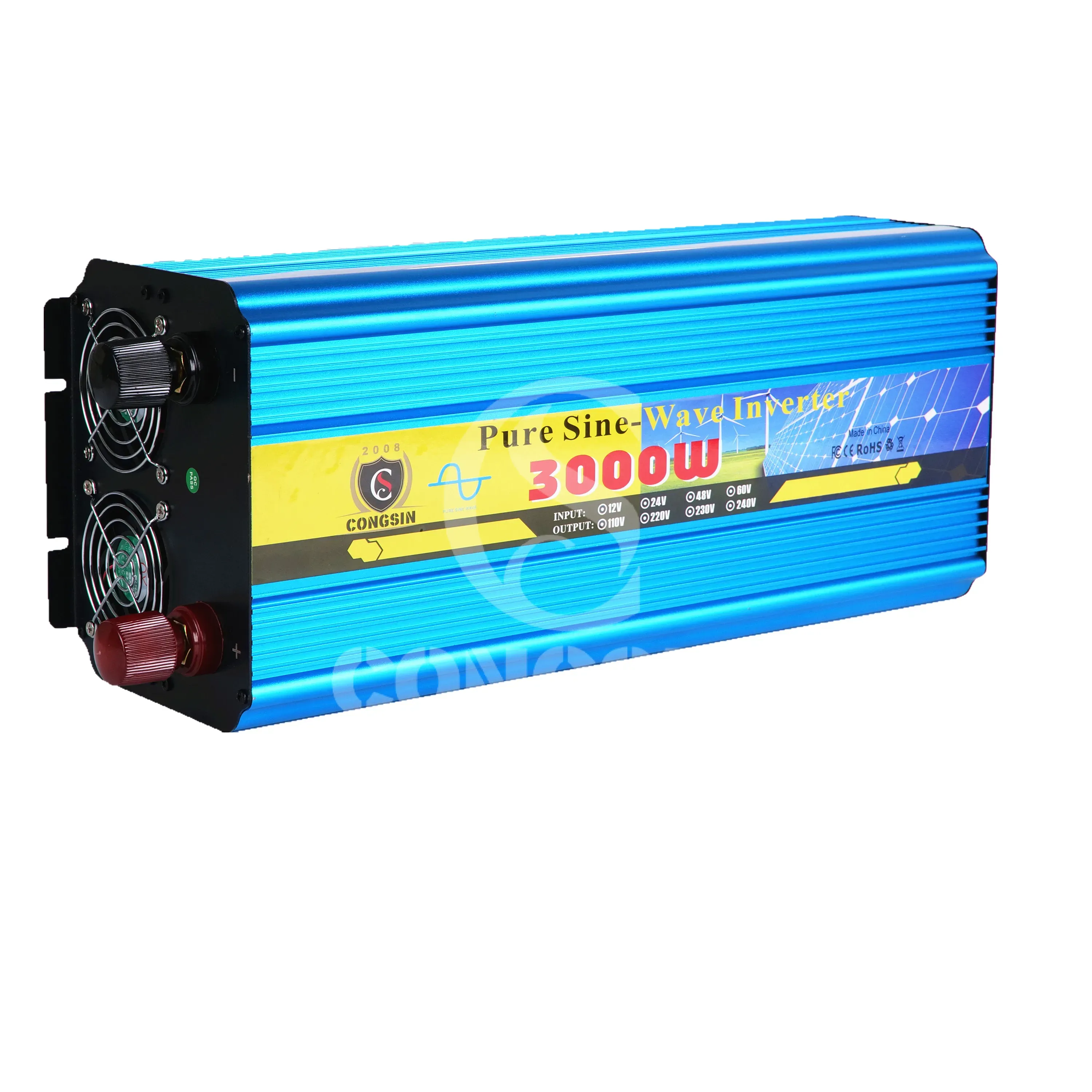
Congsin 3000W LCD Pure Sine Wave Inverter for Home Use Solar Backup Power Inverter Off Grid UPS
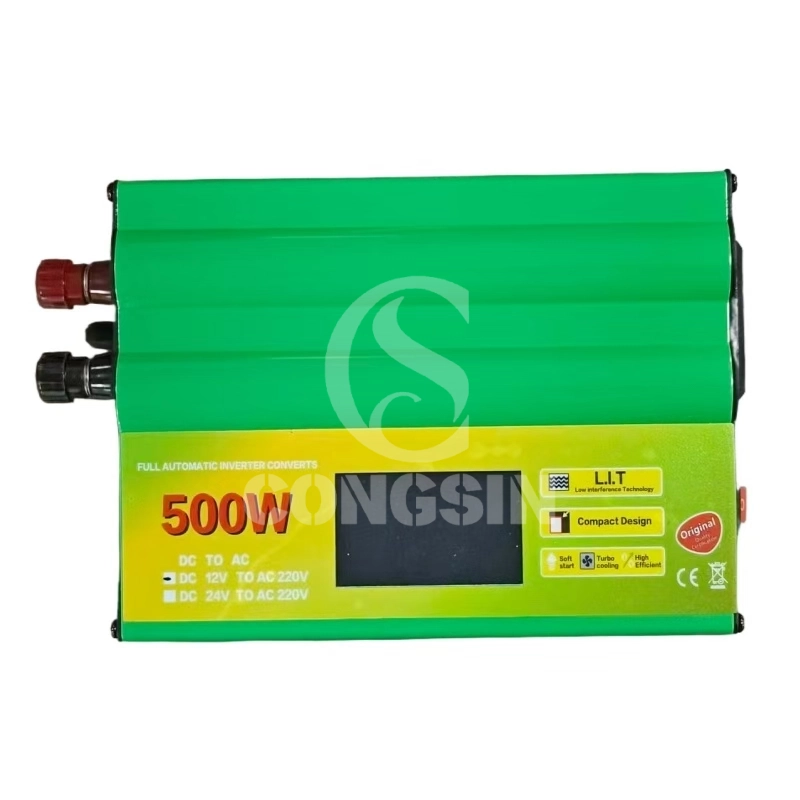
Congsin Modified Sine Wave Inverter 500W 1000W 1500W 12V LED Display Portable for RV Car Solar
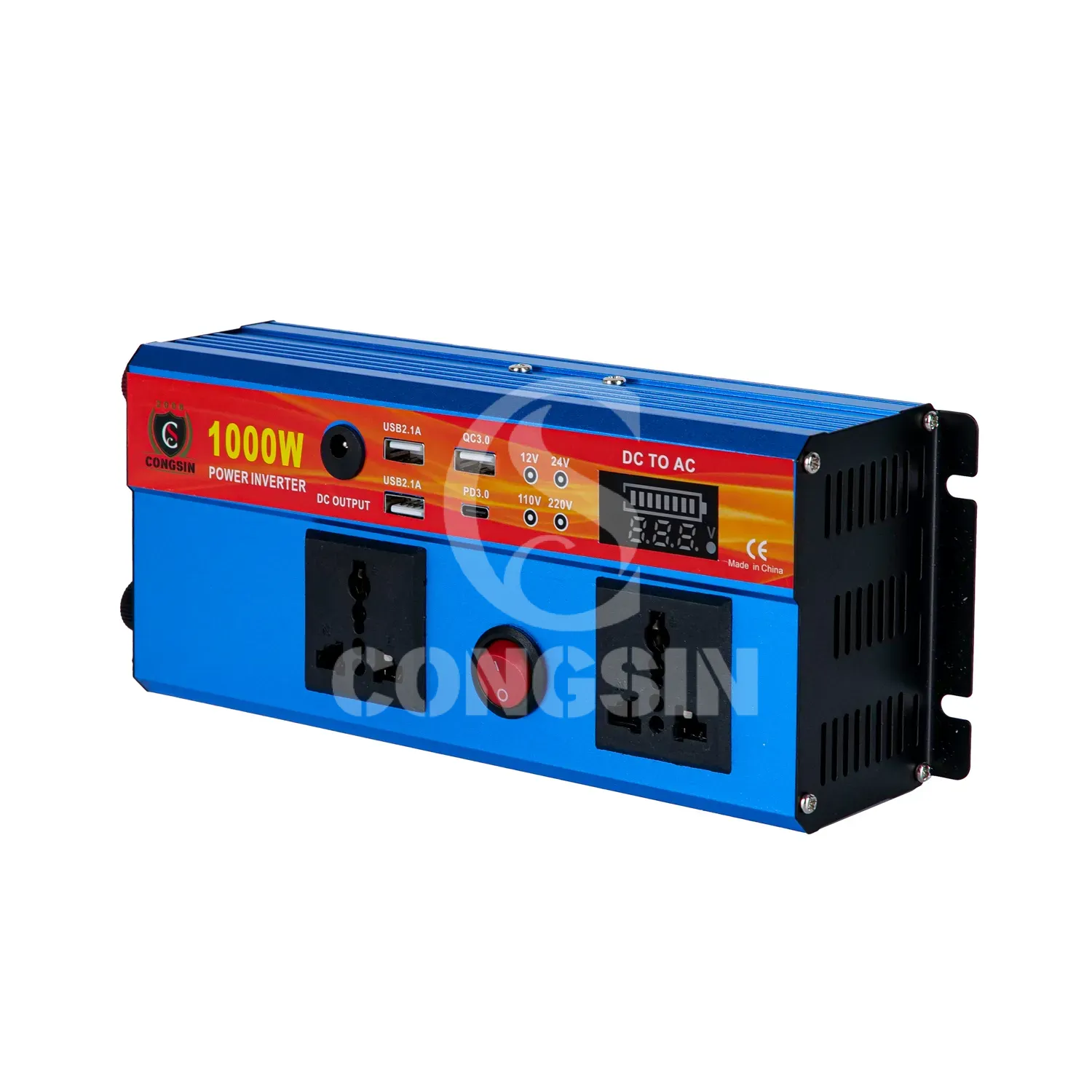
Congsin 1000W modified sine wave inverter with LED display and Type C port car RV power inverter
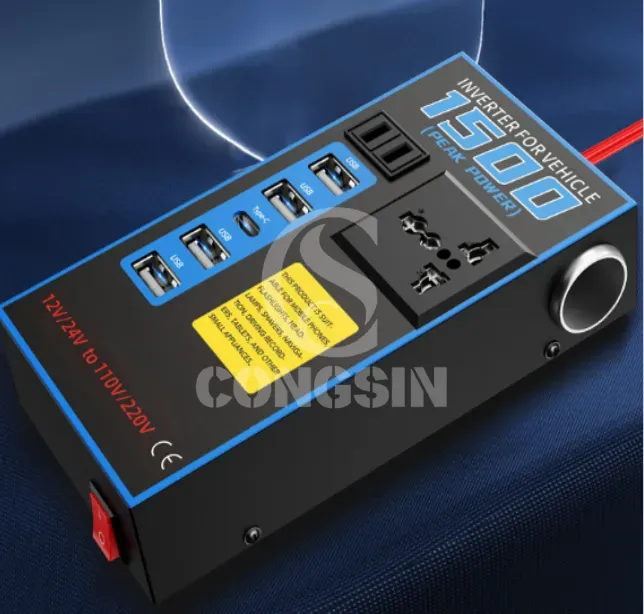
Congsin 1500W Inverter for Vehicle DC 12V/24V to AC 110V/220V with Universal socket Modified Sine Wave

CONGSIN is a trusted OEM factory for power inverters, solar charge controllers, and DC converters. Reliable solutions for global B2B buyers.
 High Quality
 7/24 Service
 Guaranteed Warranty
© 2025 Congsin. All Rights Reserved.